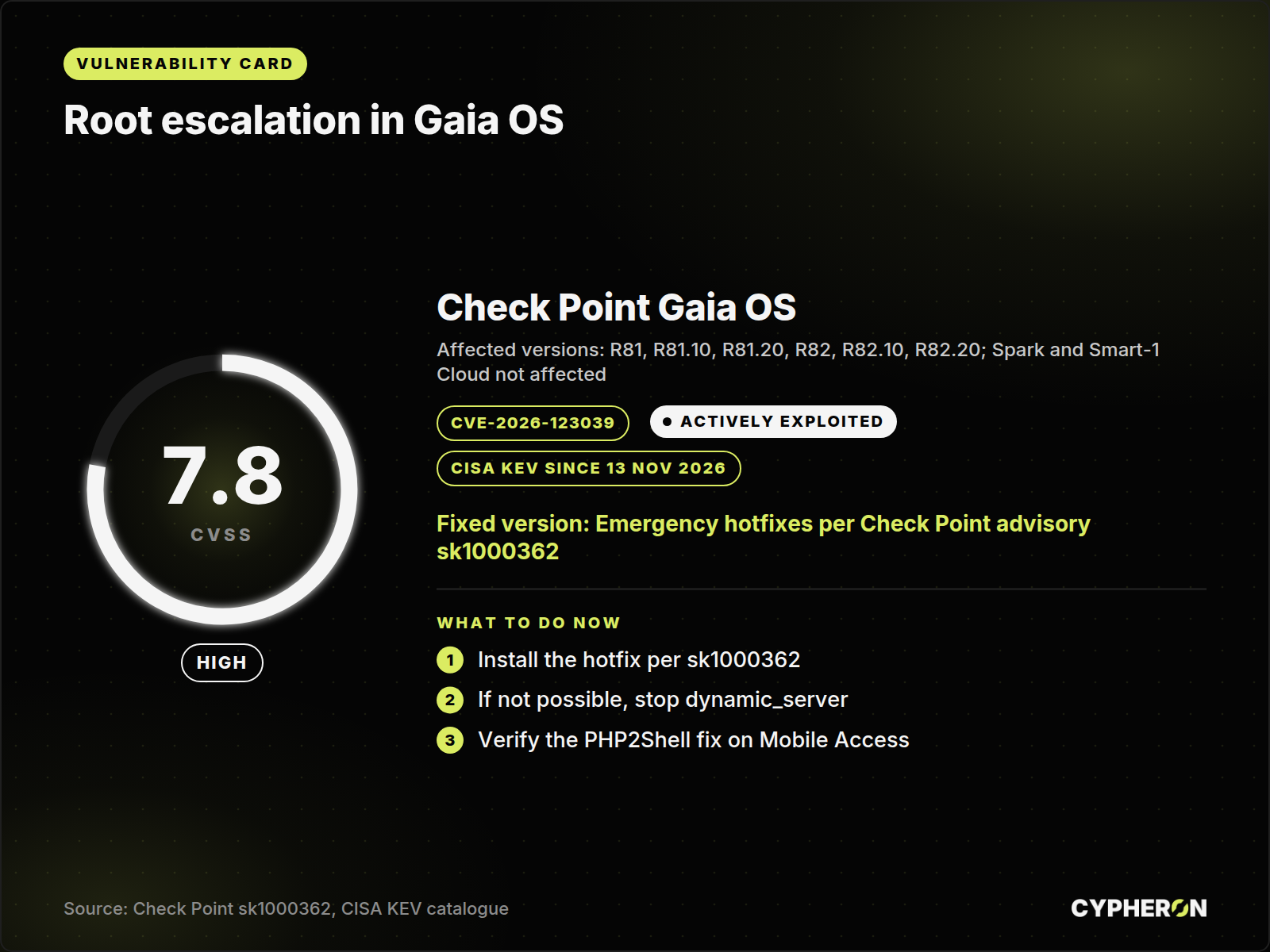
Check Point has released emergency hotfixes for a flaw in the Gaia operating system that attackers have been exploiting since late October to gain root privileges on security gateways. On its own the flaw is a privilege escalation and needs access on the device itself. Attackers get there from the outside through the PHP2Shell vulnerabilities in the Mobile Access portal, so the two flaws together form a path from the internet to full control of the gateway. CISA added the flaw to its catalogue of exploited vulnerabilities on 13 November 2026.
What happened
Gaia is the operating system of Check Point security gateways and management servers. The dynamic_server daemon behind the DynamicCLI interface runs as root and listens on a local socket that anyone can write to, and it does not verify which process connects to it. Anyone with any local access on the device, including the service account of the web portal, can send a command to the socket and have it executed as root. The flaw is tracked as CVE-2026-123039 with a CVSS score of 7.8.
In advisory sk1000362 Check Point states that it observed exploitation against a couple of dozen customers and has released emergency hotfixes.
The Check Point Research team described the attack in a report published on 12 November 2026. From 30 October attackers reached gateways with a Mobile Access portal through the PHP2Shell vulnerabilities (CVE-2026-109618 and CVE-2026-109619), escalated to root through the DynamicCLI interface, uploaded PHP webshells into the portal template directory and installed the TSGA backdoor with its TSProxy component. In the investigated intrusion they moved over SSH from the gateway to a VMware ESXi host and ran a wiper there, malware that destroys data. The first wave on 30 October targeted organisations in Israel and was destructive in some cases. A second wave on 2 November was broader, hit organisations in several countries and sectors, and the team saw no destructive activity in it. According to Check Point Research, TSGA and TSProxy are modified variants of the PhiliKit framework known from attacks on Ivanti appliances. The researchers do not consider the origin of the campaign confirmed.
Does it affect you?
According to the vendor advisory the affected products are Security Gateway, Firewall, Security Management Server, Multi-Domain Security Management Server and Scalable Platforms in releases R81, R81.10, R81.20, R82, R82.10 and R82.20. In its catalogue entry CISA states that Spark firewalls and the Smart-1 Cloud service are not affected.
The highest risk is on gateways that expose the Mobile Access portal to the internet and do not have the PHP2Shell fix installed. There an attacker only needs to chain the two flaws and requires no account at all.
What to do now
- Install the hotfix for your Gaia release as described in Check Point advisory sk1000362.
- If that is not possible right away, use the vendor mitigation: stop the dynamic_server process and prevent it from restarting.
- Check that the Mobile Access portal has the PHP2Shell fix installed and consider whether it has to be reachable from the internet.
- If the portal was exposed and unpatched, treat the gateway as possibly compromised and go through the indicators below before you simply install the fix.
How to tell whether you have been breached
Check Point has published indicators of compromise. Based on the vendor advisory and the Check Point Research report, these traces are worth checking.
- Commands that did not go through the default Clish wrapper, and use of the system() sink, which is almost absent from legitimate traffic.
- PHP session files in the temporary directory of the portal carrying the upload_progress_pwn marker, and large numbers of crashes of Apache and PHP worker processes on the portal.
- Unknown templates in the portal directory, in the investigated case files named zz*.tpl and a file named challenge_render.tpl.
- The files /tmp/CPconfigdaemon and slot_CPconfigdaemon in the boot persistence directory, and the library /lib/libcpfwcommon.so.
If you find any of these, assume the attacker had root on the gateway. A gateway sees into the network and holds credentials: rotate the passwords and keys stored on it and review the systems reachable from it, above all virtualisation accessible over SSH.
No time to track this?
Keeping up with fixes for edge devices is daily work and it slips easily in a company without its own security team. We can go through which devices you expose to the internet, how quickly a fix reaches them and what to do when a fix cannot be installed at once. The first consultation is free and can be arranged through our contact page. If you are dealing with a suspected breach right now, start with the Under attack page.
Sources: Check Point sk1000362, advisory for CVE-2026-123039 · Check Point Research, PHP2Shell exploitation on Check Point gateways · CISA, Known Exploited Vulnerabilities catalogue · NVD, CVE-2026-123039 record · BleepingComputer, case summary