Security by Design: Security Isn't a Patch — It's a Foundation
The most common mistake in cybersecurity? A company builds a system, launches an application, or introduces a new process — and only then starts asking how to secure it. By that point, it's usually too late for security to be truly effective. And too expensive to be done properly.
Security by Design isn't a buzzword or a consultant's construct. It's a way of thinking — and a concrete methodology — that says one simple thing: security must be part of the design from the very beginning, not added at the end like a coat of paint.
That sounds obvious. Yet it's the exact opposite of how most organisations approach cybersecurity.
Why Late Security Costs More
When a company builds an application or infrastructure without a security design and then discovers a problem, they essentially have two options: completely rework the system, or bolt security controls on from the outside. The first is expensive and time-consuming. The second is cheaper — but significantly less effective.
The second option is far more common in practice. And that's why we have so many security incidents in systems that "have antivirus and a firewall."
Security by Design says: neither option is necessary if you plan security from the beginning.
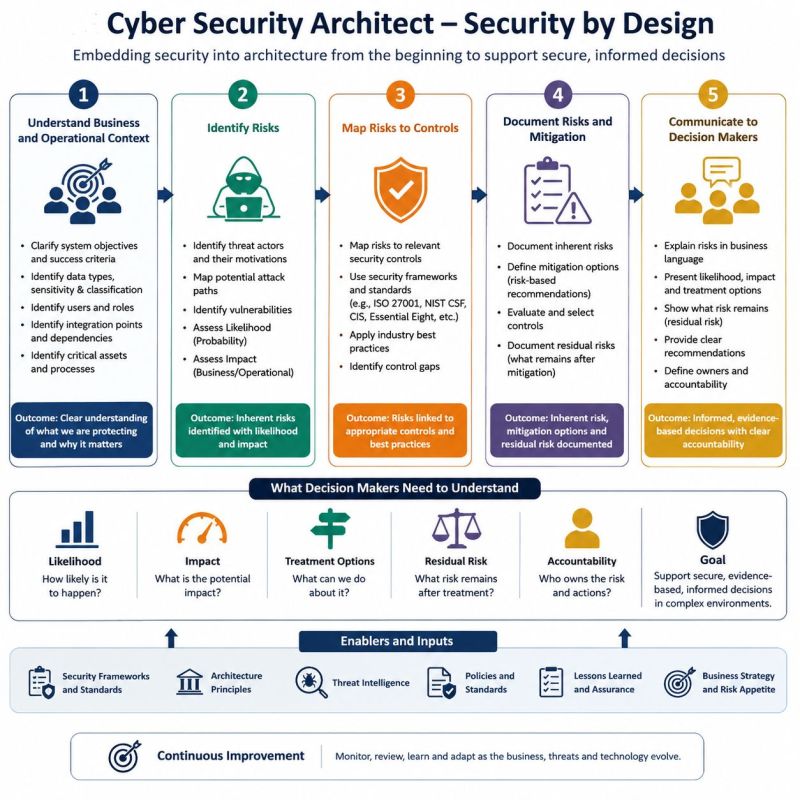
Five Steps of Secure Architecture
Understanding What You're Actually Protecting — and Why It Matters
Before talking about threats or solutions, you need to know what's at stake. What are the system's objectives? What data do you process — and how sensitive is it? Who are the users and what are their permissions? Where are the integration points with other systems and processes? What are the critical parts of the business that simply couldn't function if they failed?
The result of the first step isn't a list of technologies. It's a clear answer to the question: exactly what are we protecting, and why does it matter. Without that understanding, designing any security architecture is premature — you don't know what you're defending, so you don't know what you're defending against.
Who, Through What, and How — the Risk Map
Only once you know what you're protecting does it make sense to ask about threats. Who might attack you, and what's their motivation? What are the potential attack paths — how would an attacker get in? Where are the vulnerabilities in your systems, processes, or people? How likely is an attack, and what would the impact be on your operations or business results?
The outcome is a risk map with estimated likelihood and impact — these are the inherent risks: those that exist before any security controls are deployed. Only with this map in hand do you know where to focus.
Risks and Controls — What Are We Going to Do About It
We identify risks in order to know what to do about them. In this step, we map each risk to specific security controls — technical, process-based, or organisational.
We draw on established security frameworks and standards: ISO 27001, NIST CSF, CIS Controls, Essential Eight, and others. These standards don't exist to make companies spend years on audit checklists — they exist because they distil best practices from thousands of real-world incidents. They are the collective experience of the security community, codified into a usable form.
A critical part of this step is identifying control gaps: places where effective measures are missing or would be insufficient. Without this view, security investment gets scattered across areas that aren't the most critical.
What Remains Even After Controls — Residual Risk
After deploying security controls, risk doesn't disappear. It only decreases. What remains is called residual risk — and that's what company leadership accepts as a conscious decision.
Most companies skip this part, and then they're surprised when an incident occurs despite the fact that they "did something." Security controls don't guarantee zero risk. They guarantee that risk is accepted consciously, with a clear picture of its magnitude.
Documenting residual risk serves two purposes: the business knows exactly what it's choosing and what it isn't. And in the event of an incident or audit, it's clear that risks were identified, assessed, and either consciously accepted or mitigated.
Speaking the Language of Business — Not IT Jargon
The most sophisticated security architecture has no value if company leadership doesn't understand or support it. The final — and no less important — step is therefore to translate technical findings into language that owners and managers understand.
In practice, that means explaining risks in a business context. Showing the likelihood of an incident and what it would mean for operations, finances, or the company's reputation. Offering recommendations with different options and their associated costs. Unambiguously defining who is responsible for which decisions and which risks.
Decisions about security must be made by leadership — the security architecture gives them the evidence to make them.
What Decision Makers Actually Need to Know
Every cybersecurity decision should rest on five questions: How likely is it that an incident will occur? What would its impact be? What are the options for addressing the risk? What remains after the chosen controls are in place? And who is accountable?
If you don't have answers to these questions, you're deciding blind — regardless of what technology you have deployed or how expensive a firewall sits in your rack.
Security Isn't a Project — It's a State
Security by Design doesn't have a completion date. A security architecture must live and adapt: to new threats, new technologies, new regulatory requirements, and evolving business processes. What was sufficient last year may not be sufficient today — the series of zero-day vulnerabilities that appeared in Windows in recent months is a good example of that.
That's why the approach also includes ongoing monitoring, regular review, and the ability to learn from incidents — your own and others'.
Why Companies Delay — and Why That's a Mistake
The most common argument for postponing security design is time and money. Security will be "sorted out" after launch. The problem is that changing architecture after launch is an order of magnitude more expensive than designing it correctly upfront. And if an incident occurs in the meantime — an outage, a data breach, a ransomware attack — the cost rises higher still, compounded by reputational damage and customer loss.
Security by Design isn't a luxury for large corporations. It's a way of building digital environments that are resilient from the ground up — and a way of avoiding the situation where you're addressing security in crisis mode, under pressure, without preparation.
If you'd like to understand how your organisation's security architecture currently stands — or want to design a secure environment from the ground up — get in touch.
Free initial consultation. We respond within 24 hours.