An attacker who reaches the cluster database service of Cisco Expressway over the network can run arbitrary commands as root, with no authentication at all. CISA added the flaw to its Known Exploited Vulnerabilities catalogue on 20 November 2026 and gave US federal agencies three days to remediate. If you run Expressway in a cluster, this is work for this week.
What happened
Cisco Expressway is a gateway for remote access to voice and video services. Expressway-E sits at the network edge and Expressway-C is its internal counterpart. Organisations deploy them so that mobile clients and video endpoints can reach internal collaboration infrastructure without a VPN.
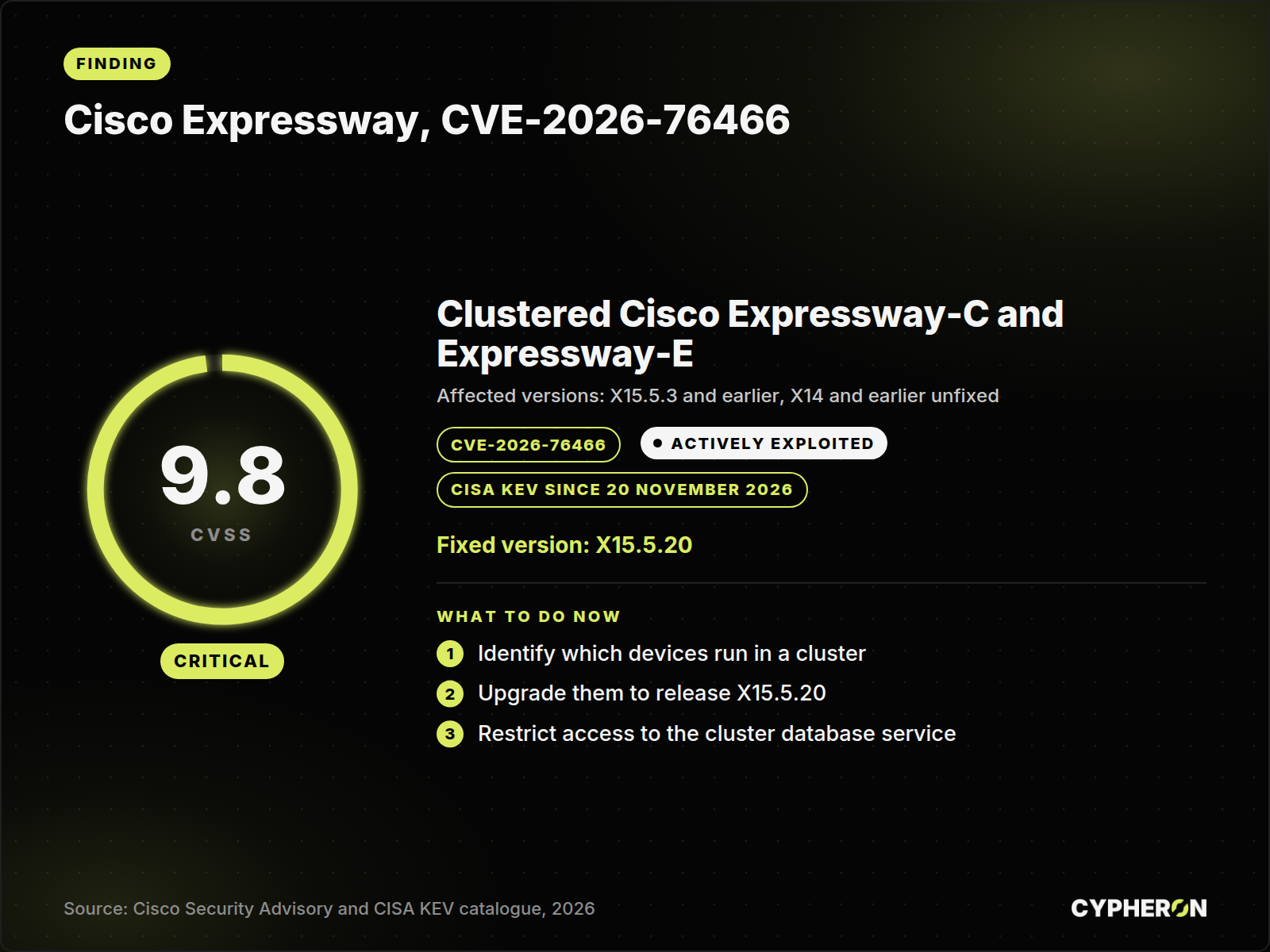
CVE-2026-76466 sits in the database service that cluster members use between themselves. According to the advisory from Cisco, the service relies on persistent cookies and, when clustering is enabled, does not validate client certificates even if TLS Verify Mode is set to Enabled. An attacker in possession of the cookies connects to the service, invokes specific remote procedure call commands and executes arbitrary operating system commands as root. Cisco classifies the issue as CWE-798, use of hard-coded credentials: they are part of the software, so configuration changes cannot remove them. The CVSS score is 9.8 and the advisory states explicitly that no workaround is available.
Sources differ on whether the flaw is being exploited. The advisory from Cisco, published on 21 October 2026, says the vendor is not aware of malicious use or of a public exploit, and that wording has not changed so far. CISA nevertheless added the flaw to its exploited vulnerabilities catalogue on 20 November 2026, points to its forensic triage requirements in the required action, and set 23 November 2026 as the deadline for federal agencies. The catalogue does not report use in ransomware campaigns.
Does this affect you?
Cisco lists Expressway-C and Expressway-E as affected, both virtual and appliance versions, if they run a vulnerable release and are configured in a cluster.
- Releases X15.5.3 and earlier in the X15 train are vulnerable.
- Releases X14 and earlier receive no fix. Devices on them have to be moved to a fixed release.
- Clustering is the deciding factor. The advisory does not treat standalone deployments as vulnerable. Setting TLS Verify Mode to Enabled does not address the flaw.
The release number is in the system overview of the device web interface and the cluster setting is in the clustering configuration. Expressway-E devices are often reachable from the internet, so start with those.
What to do now
- Go through your device inventory and establish which Expressway devices are clustered and which release they run.
- Upgrade them to release X15.5.20, which fixes the flaw. The same fix is part of the October 2026 Expressway hardening release.
- For releases X14 and earlier, plan the move to a fixed release. Until then the device cannot be patched.
- Restrict who can reach the cluster database service at all. Traffic between cluster members should not be reachable from the internet or from a general user network. This only reduces the attack surface and does not replace the upgrade.
How to tell whether you have been compromised
Cisco has published neither indicators of compromise nor a check procedure for this flaw. In its catalogue entry, CISA asks organisations to verify whether the device has been exploited, not only to patch it. In practice that means preserving device logs before the upgrade, reviewing access to the cluster database service and to the management interface, and looking for accounts, scheduled tasks and processes you cannot explain. If you find something of that kind, treat it as an incident: an attacker with root on Expressway also reaches the credentials it holds for connected systems.
Struggling to keep track?
Watching vendor advisories for every device at the network edge, and knowing which of them are deployed in a way that the flaw actually applies to, is weekly work. If nobody in the organisation has time for it, we can help: from a security assessment that shows what you have exposed to the internet, to an external security manager who runs vulnerability management continuously. The initial consultation is free of charge, so get in touch.
If you suspect somebody has already been on your device, see our page for organisations dealing with an incident.
Sources: Cisco Security Advisory, Cisco Expressway Series Remote Code Execution Vulnerability (CVE-2026-76466) · CISA, Known Exploited Vulnerabilities catalogue · NVD, CVE-2026-76466