This roundup covers Monday 16 to Friday 20 November 2026. The week had one thing in common: the flaws worth your attention were not in end-user applications but in the systems that manage everything else. A configuration management tool, a load balancer at the network edge, a gateway to language models and the installer of a content management system.
Two of the flaws are already being exploited according to the sources. CISA added a flaw in Perforce Puppet Enterprise and a flaw in the open source gateway LiteLLM to its KEV catalogue. Both have fixes out and the deadline for US federal agencies falls in early December. The third big item of the week is not being exploited, but it will touch a lot of organisations: on 18 November F5 published twenty-two advisories, six of which cover critical flaws in the BIG-IP data plane for which only an engineering hotfix exists and no workaround.
We covered five items from this week in separate alerts, so here you will only find them in the priority table: the authentication bypass in VMware vCenter that was exploited as a zero-day, the exploited flaw in Apache Axis, Java4Shell in Java SE and OpenJDK, the flaw in nginx and the critical PHP releases.
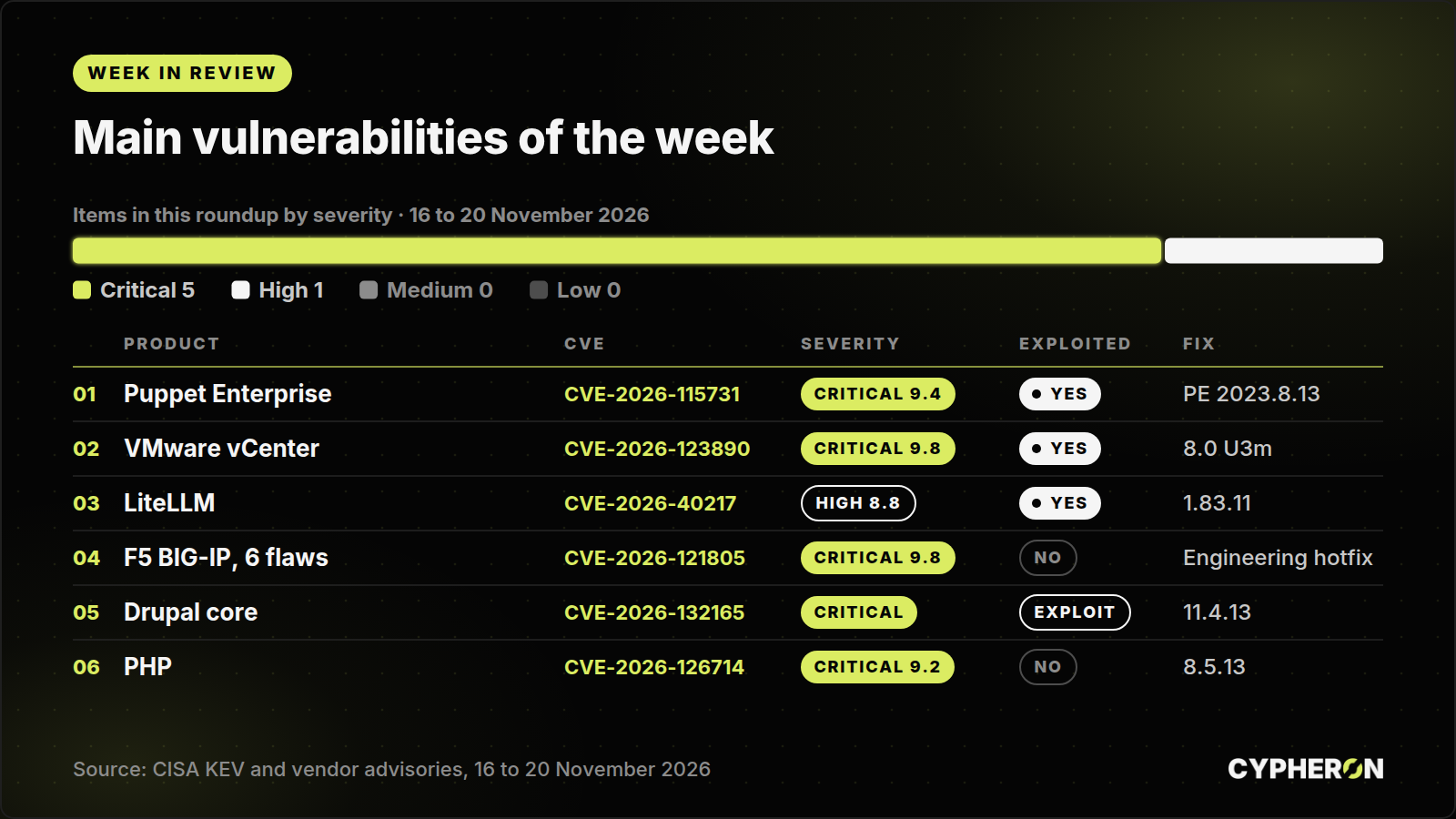
The full lists of fixed versions are in the priority table in this article.
1. F5 BIG-IP, six critical flaws can take down traffic at the network edge
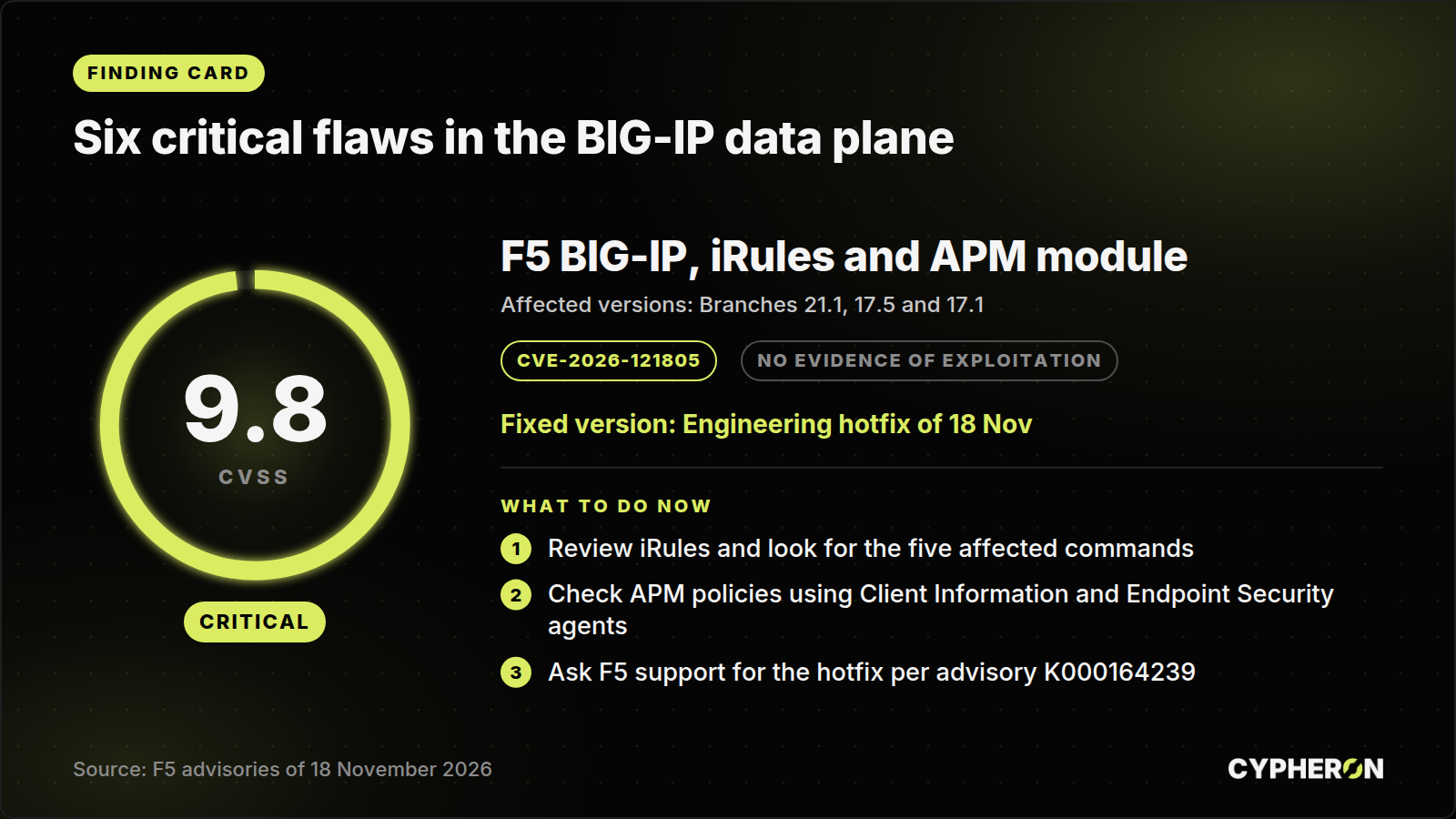
CVE-2026-121805, CVE-2026-116953, CVE-2026-120285, CVE-2026-120292, CVE-2026-120722 and CVE-2026-123637 · CVSS score 9.8 (CVSS 3.1) and 9.3 (CVSS 4.0) · no evidence of exploitation · patch available, so far only as an engineering hotfix
BIG-IP is an F5 appliance that sits in front of applications and distributes traffic between them. It does load balancing, terminates TLS, protects published websites and, in the APM module, works as an access gateway and VPN. It is a common part of the perimeter, so an outage of BIG-IP means an outage of everything behind it.
All six flaws are of the same kind: a stack-based buffer overflow in TMM, the component that processes almost all network traffic of the appliance. Five of them sit in iRules, the scripts administrators use to shape traffic handling, and relate to specific commands. The sixth is in the APM module. An attacker who does not have to log in anywhere only needs to send a suitably crafted request and the TMM process terminates; traffic is interrupted until it restarts. For all six, F5 adds that the flaw may also lead to remote code execution.
It is worse than it looks for two reasons. First, there is no standard release for these flaws yet, only an engineering hotfix, that is a build outside the normal cycle, and no workaround. Second, the flaws only trigger on a specific configuration that you have to find yourself: for five of them it is an iRule using an affected command, for the sixth an APM per-request policy that combines the Client Information agent with Endpoint Security agents. Without an inventory of your own iRules and policies you do not know whether this affects you. F5 also only checks versions still under technical support, so an older version missing from its tables has not thereby been declared safe.
What to do. Review the iRules on all virtual servers and look for the commands PEM::subscriber, MR::message route, PSC::ip_address, GENERICMESSAGE::route and DNS::scrape. In the APM module, look for per-request policies combining the Client Information agent with Endpoint Security agents. If you have such a configuration, ask F5 support for the engineering hotfix for your version; F5 issued separate guidance in advisory K000164239. Until you have the hotfix, consider whether the affected iRule command or the APM agent combination can be temporarily rewritten or switched off; the data plane itself cannot be hidden from the internet. A separate flaw in the iControl REST interface (CVE-2026-120718, CVSS score 8.1) is fixed in the standard releases 21.1.0.2, 17.5.1.10 and 17.1.3.6, which you can deploy the usual way.
2. Puppet Enterprise, a report from an agent runs code on the management server
CVE-2026-115731 · CVSS score 9.4 (CVSS 4.0, Perforce) and 9.9 (CVSS 3.1, NVD) · actively exploited · patch available
Puppet is a configuration management tool. An agent runs on each server, takes the description of the desired state from Puppet Server and reports the result back to it. In an organisation that uses it, one server therefore holds the configuration of tens or hundreds of others.
The flaw is in the code that processes those reports. A report can contain a so-called rich data type and Puppet Server deserialises it, that is builds objects out of the submitted data, without sufficient checks. A client holding any certificate signed by the Puppet certificate authority can send a crafted report in a PUT request and run its own code on the server as the service user. If the certificate authority signs requests automatically without strong verification, that is in permissive autosign mode, an attacker from outside can obtain a certificate too and needs no login at all.
Why this is worse than it looks: Puppet Server holds the signing key of the certificate authority and can change the configuration of the whole estate. Whoever runs code on it gains control over the management of the servers Puppet administers, including the ability to push its own configuration to them. CISA added the flaw to the KEV catalogue on 17 November 2026, that is to the list of flaws demonstrably being exploited, and gave US federal agencies a deadline of 1 December 2026.
What to do. The fixes were released on 3 November 2026: Puppet Enterprise 2023.8.13, 2025.12.1 and 2026.0.1, Puppet Core 9.1.3 and 8.22.2. Derived projects are affected as well, namely OpenVox and Red Hat Satellite; for those follow the advisory of the respective vendor. Until you deploy the fix, turn off permissive autosign and restrict where port 8140 of Puppet Server can be reached from. After patching, review the report processing logs and the history of signed agent certificates for a certificate you never requested.
3. LiteLLM, a sandbox escape in the gateway to language models
CVE-2026-40217 · CVSS score 8.8 (CVSS 3.1) · actively exploited · patch available
LiteLLM is an open source gateway through which organisations send queries to language models from various providers. It holds the API keys to those providers and issues its own so-called virtual keys to individual teams and applications so that usage can be measured and limited.
Part of the gateway is the /guardrails/test_custom_code endpoint, which runs Python code submitted by a user so that custom content checks can be tested. The code was meant to run in a sandbox built on filtering source text with regular expressions. Such a sandbox can be bypassed by rewriting bytecode, which allows arbitrary code to run in the gateway process, and in the default Docker image that process runs as root. In the default configuration, only an account with proxy admin rights can reach the affected endpoint.
What makes it worse is how the flaw is used in practice. On 17 November 2026 the Google Threat Intelligence Group said it had observed an attacker using this flaw to turn limited virtual keys into full administrative credentials. Two further flaws in the same project, CVE-2026-47101 and CVE-2026-47102, provide a path from an ordinary user to administrator, so together they form a chain from a weak key to a shell on the server that holds the provider keys. CISA added the flaw to the KEV catalogue on 18 November 2026 with a deadline of 2 December 2026.
What to do. Upgrade to version 1.83.11 or later, in which the maintainers replaced their own sandbox with the RestrictedPython library. Mind the difference between sources: the text of the advisory on GitHub mentions 1.83.11, while the machine-readable range of affected versions in the same advisory says 1.83.10; the safer choice is to stay with 1.83.11. Until you can upgrade, block POST requests to /guardrails/test_custom_code on the reverse proxy, do not run the gateway as root and do not expose the administrative interface to untrusted networks. If the administrative interface was reachable from outside, rotate both the gateway keys and the API keys to the model providers.
4. Drupal, the installer allows a site to be installed again
CVE-2026-132165 · rated by Drupal as 18 out of 25, that is critical; no CVSS score published by NVD as of 20 November 2026 · public proof of concept exploit · patch available
Drupal is a content management system running the websites of companies and public bodies. It ships with the /core/install.php script, which is used to install a site for the first time. After installation it stays on the site and the default rules in the .htaccess file do not block access to it.
That is exactly where the flaw is. Under specific conditions it allows an attacker without a login to bypass the check that the site is already installed, start the installation again with database credentials of their own and overwrite the settings.php file. The result is a site takeover or code execution on the server. The flaw was found by the OSS Scanner tool from Anthropic. Many attack paths are, however, closed by read-only permissions on settings.php, which is why the project rates the vulnerable configuration as uncommon and the flaw as critical rather than at the highest level.
Why not to leave it sitting: the proof of concept code is public and the Drupal security team warns that working exploitation may arrive quickly. As of 20 November 2026 neither the project nor the analysts who examined the flaw report exploitation. At the same time this is a flaw that takes a single request to a public address, so it is easy to find by scanning the internet.
What to do. Update core to 10.6.22, 11.3.22 or 11.4.13, released on 18 November 2026. Sites on Drupal 8, 9, 10.5 and 11.2 are past end of life and will get no fix; those need to be moved to a supported branch. Until you can update, block public access to /core/install.php in the web server configuration or in the .htaccess file and verify that the web server cannot write to settings.php or change its permissions. The same release also fixes CVE-2026-132166, a flaw of lower severity that can only be exploited together with another deserialisation flaw and with an administrator login.
Priority summary
| Vulnerability | Impact | Exploited | Patch | Priority |
|---|---|---|---|---|
| Puppet Enterprise, CVE-2026-115731 | Code execution on the management server | Yes | PE 2023.8.13, 2025.12.1, 2026.0.1 | Immediately |
| VMware vCenter, CVE-2026-123890 | Administrator rights without a password | Yes | 9.1.1.0200, 9.0.2.0200, 8.0 U3m | Immediately |
| LiteLLM, CVE-2026-40217 | Code execution in the gateway to models | Yes | 1.83.11 | Immediately |
| Apache Axis, CVE-2026-90436 | Code execution via a SOAP message | Yes | No patch, product past end of life | Immediately |
| F5 BIG-IP, CVE-2026-121805 and five more | Data plane crash, possible code execution | No | Engineering hotfix of 18 November 2026 | High |
| Drupal, CVE-2026-132165 | Site takeover without a login | No, public exploit | 10.6.22, 11.3.22, 11.4.13 | High |
| nginx, CVE-2026-123007 | Code execution without logging in | No | 1.31.9, 1.30.7 | High |
| PHP, CVE-2026-126714 and CVE-2026-129481 | Code execution on non-default configurations | No | 8.5.13, 8.4.28, 8.3.37, 8.2.36 | High |
| Java SE and OpenJDK, CVE-2026-114938 | Application crash, in some cases code execution | No, scanning under way | 17.0.21.1, 21.0.13.1, 25.0.5.1, 27.0.1.1 | High |
Elsewhere in security
An intruder reached the cloud behind an email filtering service
N-able, which supplies tools to IT service providers, disclosed on 18 November 2026 that an unknown attacker gained unauthorised access to one of the servers in its cloud for the Mail Assure and SpamExperts services, that is for email filtering. As a result the company disabled the management portal and the API in three regions, including Europe. The sequence is instructive: on 16 November the status page described an outage, on 17 November the company attributed it to platform configuration and only on 18 November reassessed it as a security incident. According to the company, mail filtering and delivery keep running, while quarantine, logging and mailbox synchronisation stayed unavailable. N-able said that at this time it has no evidence of compromise of customer data and added that the investigation continues.
Review which security functions your supplier performs for you, and what you will do when its portal and API disappear for several days.
The ClickFix lure now also delivers a remote access tool
According to a report by Blackpoint Cyber published on 20 November 2026, the ROMULUS platform, first described by Forescout Research in October 2026, now delivers a previously undocumented remote access tool. ROMULUS works as a delivery service for several malware families and relies on ClickFix-style lures, where a page persuades a person to run a prepared command themselves under the pretext of a fix or a verification. According to the researchers, in some campaigns custom GPTs built in ChatGPT also led victims to the fraudulent pages.
Check whether your people can run a command handed to them by a web browser, and whether you would see it in your logs.
What to take away from this week
Two observations. First, an agent certificate, a virtual key into a gateway or access to the virtualisation console are today worth as much as a domain administrator password. In both Puppet and LiteLLM the way in was through legitimate, routinely issued access, not through a forgotten server at the edge of the network. Second, the gateway to language models has moved from an experiment into production in a matter of months, and with that into the catalogue of exploited vulnerabilities. If someone in your organisation has deployed one, it belongs in the same inventory as a database or a domain controller.
A task for this week: list the systems that can change the configuration of other systems or log in on their behalf. Virtualisation, configuration management, pipelines, load balancers, identity management, the gateway to language models. For each of them note who can reach its administrative interface and from where. One afternoon is enough for the list, and it will set your patching order for months ahead.
Not able to keep up?
We publish this roundup every week. Following it is only the first step. The harder part is knowing which vulnerabilities affect you specifically, in what order to deal with them and who in the company is responsible for it.
That is where we help: security assessment and vulnerability management · external security manager · selection and deployment of technologies
A no-obligation consultation · Dealing with an incident right now?
We will tell you plainly what is worth addressing first. The initial consultation is free of charge.
Sources: CISA, Known Exploited Vulnerabilities catalogue · F5, advisory K000163937 on the APM module flaw · Perforce, advisory on CVE-2026-115731 in Puppet · GitHub Advisory, sandbox escape in LiteLLM · X41 D-Sec, discovery of the LiteLLM flaw · Drupal, advisory SA-CORE-2026-017 · N-able, status page for the incident · The Hacker News, topics of the week