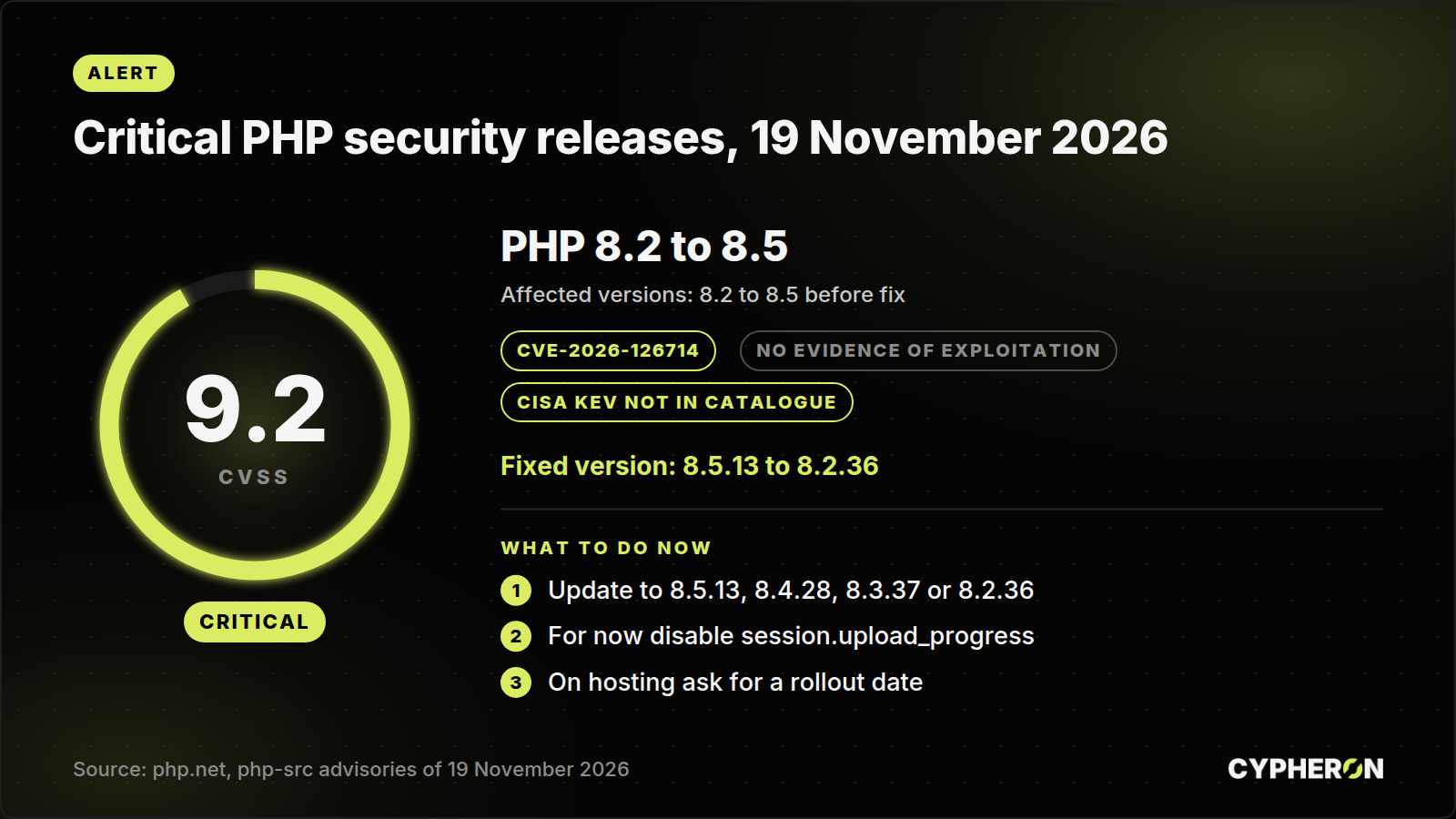
The PHP development team today, on 19 November 2026, released security fixes for all supported branches: versions 8.5.13, 8.4.28, 8.3.37 and 8.2.36. Six issues are rated critical in the project security advisories and the two most severe ones carry a CVSS score of 9.2. No exploitation has been confirmed so far.
What happened
PHP is a scripting language that runs a large share of corporate websites, online shops and internal applications. The team announced the releases on 18 November and published the description of the individual issues today. A new major version, PHP 8.6.0, was released on the same day.
The project advisories rate the following issues as critical:
- CVE-2026-126714 (CVSS 9.2): the default file based session storage can, after an interrupted write, leave a file holding a mix of two sessions, the start of the new one and the end of the old one. An attacker who can influence session contents and interrupt the write may therefore get PHP to create objects from attacker controlled data when the session is next opened. With a suitable gadget chain in the application this leads to remote code execution.
- CVE-2026-129481 (CVSS 9.2): after an interrupted session shutdown PHP keeps a pointer into memory that has already been released, and a later request served by the same worker can release it again. It affects branch 8.3 and newer, not 8.2. According to the advisory this is an incomplete fix of CVE-2026-109619 and code execution through this path has not been demonstrated.
- CVE-2026-129496: PHP can retain a reference to a freed timezone cache if a diagnostic is written to a file based error log during process startup. One confirmed precondition is an invalid date.timezone value. A remote attacker can then corrupt the memory of a worker and, according to the advisory, possibly execute code with its privileges.
- CVE-2026-129474: a use after free in magic method backtraces which, according to the advisory, can lead to remote code execution.
- CVE-2026-129182: a use after free involving the global variable holding the last fatal error backtrace after request shutdown.
- CVE-2026-129289: PHP-FPM allows request smuggling when the body of an HTTP request is left unread.
Besides the critical issues, the releases fix a local privilege escalation in PHP-FPM (CVE-2026-129291), an out of bounds read and write in PHP-CGI during PATH_INFO correction (CVE-2026-129538) and a flaw in the PHP-FPM status page output (CVE-2026-129292).
The announcement of 18 November said that the critical issues require a non default configuration. The published descriptions show that this holds only in part. The most severe issue concerns the default file based session storage, although it needs further conditions, mainly the ability to influence session contents, an interruption of the write at a useful point and a suitable gadget chain in the application. Nobody has confirmed exploitation of these issues so far and they are not listed in the CISA KEV catalogue of exploited vulnerabilities.
Does it affect you?
It affects every server, container or hosting service running PHP. The affected versions are 8.2.0 to 8.2.35, 8.3.0 to 8.3.36, 8.4.0 to 8.4.27 and 8.5.0 to 8.5.12. The fixed versions are 8.2.36, 8.3.37, 8.4.28 and 8.5.13. Branches that the PHP team no longer supports, that is 8.1 and older, will not receive a fix and the only option there is to move to a supported branch.
You can check the version on a server with php -v. On shared hosting or a managed platform, ask the provider when they will deploy the fix. If you are considering the new major version 8.6.0, work from its release notes: the advisories for these issues list branches 8.2 to 8.5 as affected.
What to do now
- Update PHP to 8.5.13, 8.4.28, 8.3.37 or 8.2.36 depending on the branch you run. Packages for Debian, Ubuntu and RHEL usually follow several hours to several days after the release on php.net.
- Until you deploy the update, disable session.upload_progress.enabled if you do not need the feature. It removes one path through which an attacker can influence session contents, but it does not help applications that store user supplied data in sessions themselves.
- Check that date.timezone in php.ini holds a valid value. An invalid value is one of the confirmed preconditions of CVE-2026-129496.
- Where a PHP-FPM update has to wait, the advisory suggests setting pm.max_requests=1 and restarting the workers. That costs performance and works only as a temporary measure.
- Do not leave the PHP-FPM status page reachable from the internet.
- After updating, review whether an unsupported PHP branch is still running somewhere. Those branches will not receive fixes any more.
Struggling to keep track?
Following vendor advisories and deciding what to deploy immediately and what can wait for a regular window is part of our daily work. If your team does not have the capacity for it, get in touch through our contact page. The first consultation is free of charge.
Sources: PHP, ChangeLog of versions 8.5.13, 8.4.28, 8.3.37 and 8.2.36 of 19 November 2026 · PHP, security advisories of the php-src project · CISA KEV catalogue, checked on 19 November 2026 · The Hacker News, report on the upcoming critical PHP releases