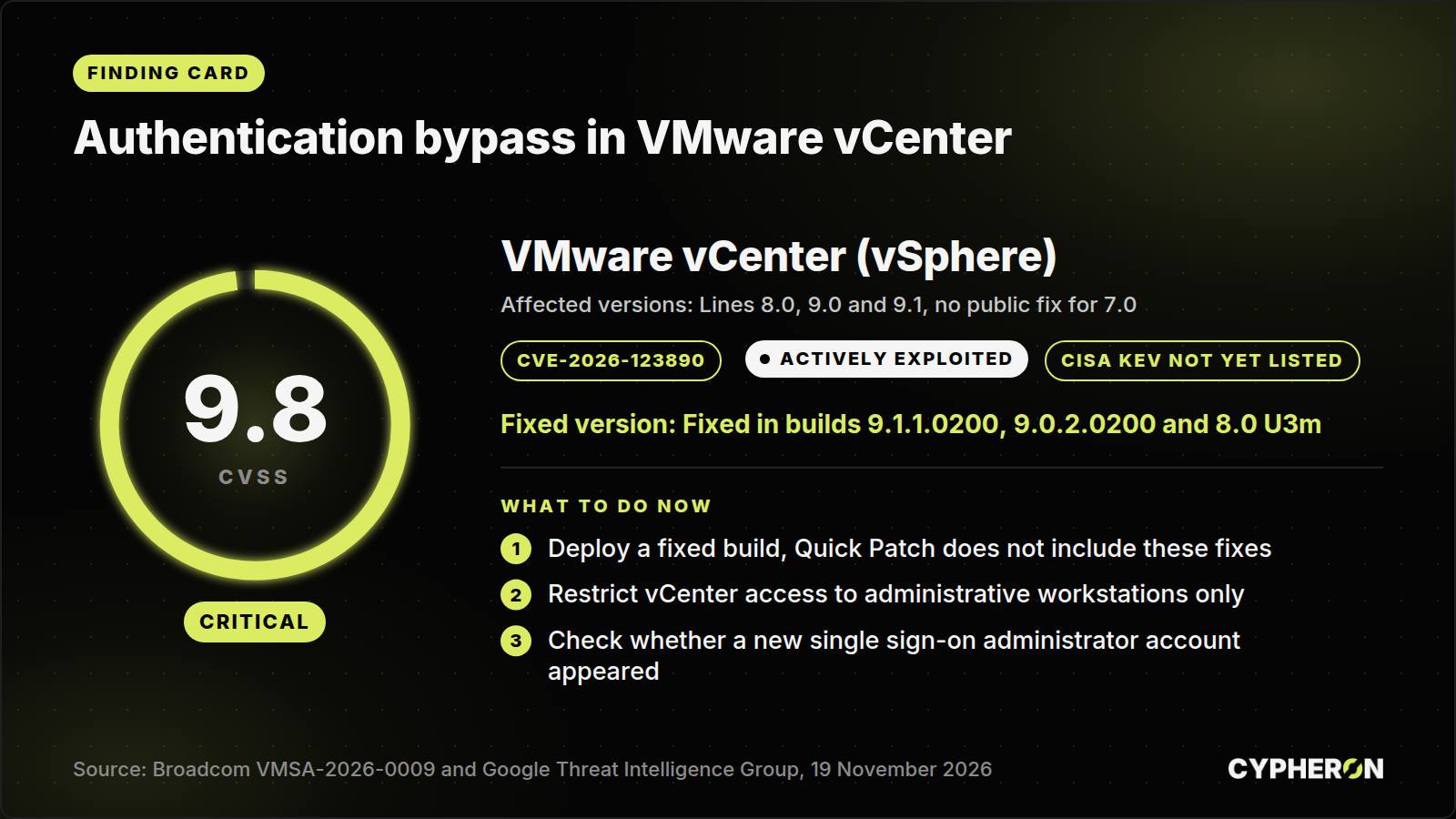
On 19 November 2026 Broadcom published security advisory VMSA-2026-0009. The most serious of the five fixed issues is CVE-2026-123890 in VMware vCenter: an attacker with network access to vCenter can bypass authentication and operate with administrator privileges. On the same day, Mandiant and the Google Threat Intelligence Group described an intrusion in which the flaw was exploited as a zero-day as early as September 2026. A fix is available and Broadcom lists no workaround.
What happened
vCenter is the central management console for VMware virtualisation. It is used to configure and monitor ESX hosts and individual virtual machines from one place. The flaw sits in its directory service, which handles logins and single sign-on. According to the technical description from the Google Threat Intelligence Group, it is a disclosure of the key used for secured communication (the SRP-6a protocol) over a DCE/RPC interface that is reachable without authentication. The attacker therefore obtains a valid session as [email protected], can run commands and can download files, including the directory service database.
Broadcom rates the flaw 9.8 out of 10 on the CVSS scale. In the accompanying questions and answers it states that for vCenter this qualifies as an emergency change under ITIL methodology and should be handled immediately in consultation with internal security staff. The advisory lists no workaround that would mitigate the issue temporarily.
On 19 November 2026 Mandiant and the Google Threat Intelligence Group published an analysis of an intrusion in which the flaw gave the group tracked as ARMORY CASTLE (previously UNC5221) access to vCenter in September 2026, two months before the fix was released. The attackers reached vCenter from another compromised device on the network, scanned for ports specific to VMware, exploited the flaw with a purpose-built tool, copied the directory database, hijacked the SAML token service and created their own single sign-on administrator account. Mandiant reported the flaw to Broadcom.
Sources differ on the exploitation status. The Broadcom advisory itself reported no attacks and no public exploit at the time of release, while the report of zero-day exploitation came the same day from Mandiant and the Google Threat Intelligence Group. The flaw was not yet listed in the CISA catalogue of known exploited vulnerabilities in the catalogue version of 18 November 2026.
Does this affect you?
The flaw is present in vCenter 8.0, 9.0 and 9.1 and in the vCenter shipped with VMware Cloud Foundation, VMware vSphere Foundation, VMware Telco Cloud Platform and VMware Telco Cloud Infrastructure, including the older Cloud Foundation 5.x line. There is no public fix for vCenter 7.0 and customers with extended support should contact Broadcom. Compare your deployed build number with the list of fixed versions in the advisory. Broadcom advises that if you are unsure whether you are affected, you should assume that you are.
The advisory also covers four further issues in SDDC Manager and in VMware Tools for Windows. These are rated lower and their exploitation requires authentication or local access. According to the Broadcom questions and answers, the advisory does not affect the ESX hypervisor and none of the five issues allows code execution on an ESX host from inside a virtual machine.
What to do now
- Deploy the fixed vCenter versions. Broadcom lists build 9.1.1.0200 for the 9.1 line, 9.0.2.0200 for the 9.0 line and 8.0 U3m for the 8.0 line. Patches are cumulative, so newer versions also resolve the issue.
- Plan for a full update rather than a quick patch. According to Broadcom the fixes in this advisory are not available through vCenter Quick Patch, and Cloud Foundation 5.x requires asynchronous patching per KB 88287.
- Until the fix is deployed, restrict network access to vCenter to administrative workstations only. The vendor lists no workaround, so separating the management network is the only way to reduce exposure.
- For vCenter 7.0, request guidance from Broadcom. There is no public fix for that line, and without extended support you should plan a move to a supported version.
The Google Threat Intelligence Group adds that applying the patch alone is not enough for vCenter, because it is the control plane of the whole virtual environment. Mandiant recommends hardening along zero trust lines and the VCSA Hardening & Logging Tool.
How to tell whether you have been compromised
Mandiant and the Google Threat Intelligence Group describe the following signs among others, with detailed indicators in their report:
- internal network scanning for ports specific to VMware, in particular 2012, 5480 and 9080, and requests to the /sdk and /ui paths,
- a single sign-on administrator account that none of your staff created,
- a download or copy of the vCenter directory service database,
- a webshell on internal Linux appliances, especially those without EDR coverage.
If you find any of these signs, assume that applying the patch alone will not end the attacker access. The description of the intrusion indicates that the attacker could take away the contents of the directory database and control over SAML token issuance. In that case, rotate credentials and single sign-on signing certificates, follow the Broadcom guidance and bring in forensic support.
Short on time to track this?
Vulnerability management means more than applying a patch. You need to know which systems you actually run, who administers them, what is allowed to reach their management interfaces and how you can demonstrate when and how a specific flaw was resolved. We help organisations set up and run that process, including environments where one person handles security alongside day to day IT. If you want to know where you stand, we offer a security assessment. If you are dealing with an intrusion right now, see our under attack page or get in touch. The initial consultation is free of charge.
Sources: Broadcom, questions and answers on VMSA-2026-0009 · Google Threat Intelligence Group and Mandiant, analysis of CVE-2026-123890 exploitation · CISA, known exploited vulnerabilities catalogue · The Hacker News, report on the Broadcom advisory