On 25 November 2026 the US agency CISA added five flaws in the Audio, Web and Video Conferencing (AWV) component of the Mitel MiCollab platform to its catalogue of exploited vulnerabilities. Mitel rates two of them as critical and they can be abused over the network without any login, with the impact of running commands on the server. If your MiCollab conferencing component is reachable from the internet, this is work for today.
What happened
MiCollab is a business communications platform: telephony, chat, screen sharing and conferencing on a single server. The affected AWV component serves web and video conferences, so it is often published to the internet to let people outside the corporate network join calls. That is exactly where these flaws are.
Mitel described them in advisory MISA-2026-0012 (first issued 16 November 2026, revision 2.0 of 24 November 2026):
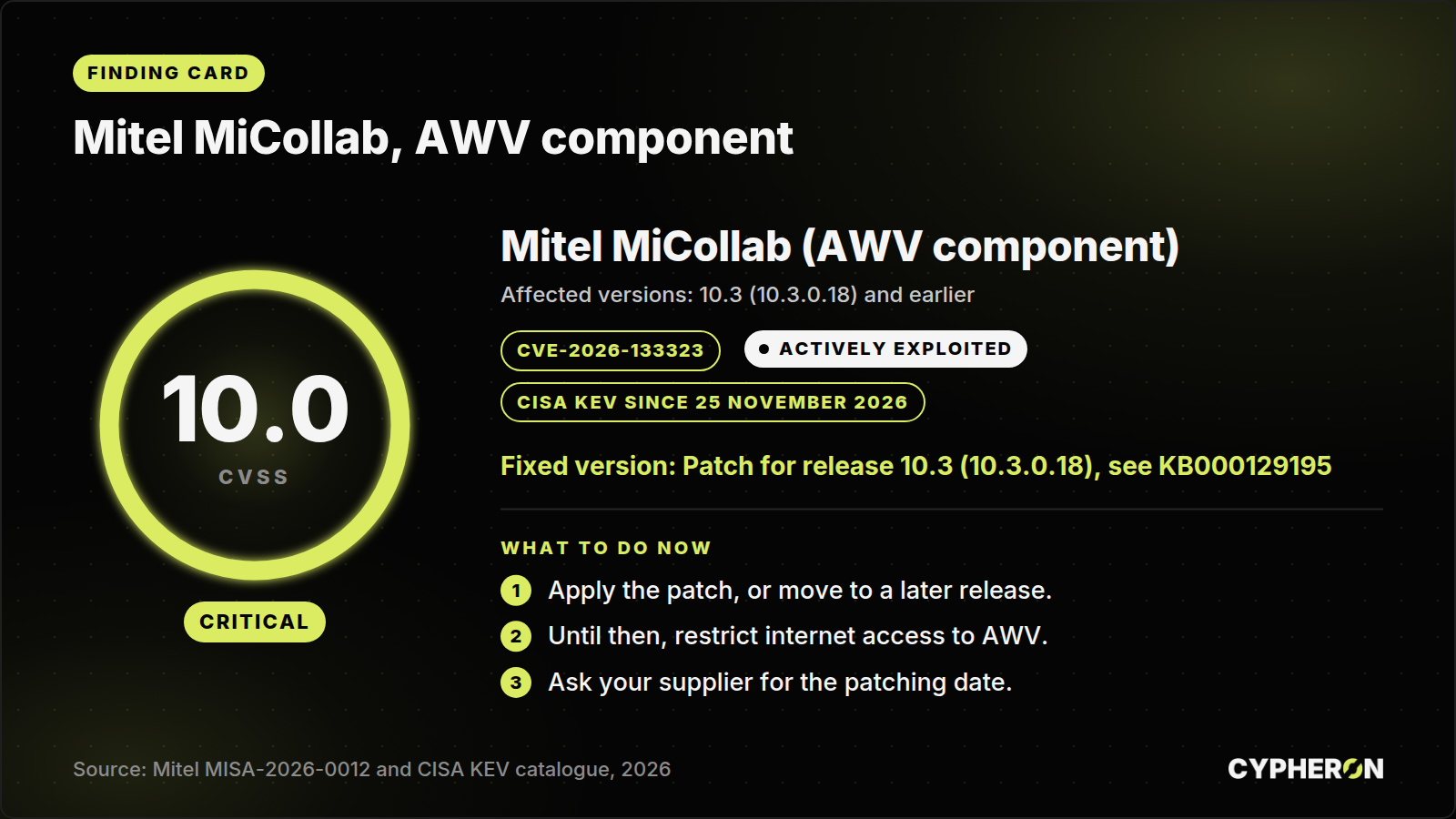
- CVE-2026-133323, OS command injection, rated critical by Mitel, CVSS 3.1 score 10.0 (AV:N/AC:L/PR:N/UI:N). Because of insufficient parameter sanitisation, an unauthenticated attacker can run commands in the context of the system.
- CVE-2026-133303, XML injection, rated critical by Mitel, CVSS 9.0. Using pre-staged content, an unauthenticated attacker can also run commands in the context of the system.
- CVE-2026-133275 (5.3), upload of a file of any type due to insufficient file type validation.
- CVE-2026-133311 (5.9), access to sensitive information where the attacker knows a specific system generated identifier.
- CVE-2026-133324 (5.3), authentication bypass and unauthorised actions within the application.
Mitel warns in the advisory that exploiting the flaws together significantly amplifies their impact. That matters: an upload that looks minor on its own makes sense as the first step for an attacker to stage content that is then executed through the XML or command injection.
Exploitation is confirmed by CISA, which has listed all five flaws in its catalogue of exploited vulnerabilities since 25 November 2026. US federal agencies must remediate four of them by 28 November 2026 and CVE-2026-133311 by 9 December 2026. CISA has published no details about the attacks, no attacker names and no numbers of compromised systems, and Mitel does not mention exploitation in its advisory.
Does this affect you?
According to Mitel the affected versions are MiCollab 10.3 (10.3.0.18) and earlier. The advisory covers supported releases only, so assume that products past end of support will not receive the fix.
What to check:
- Whether you run MiCollab at all and in which version. In smaller organisations the telephony platform is usually managed by an external supplier, so the answer often sits with the partner rather than with internal IT.
- Whether the AWV component is reachable from the internet, typically through an edge gateway or a reverse proxy. If it is, treat this as urgent.
- Whether you have access to the Mitel knowledge base. The patch is downloaded from there, otherwise you get it through an authorised partner.
What to do now
- Apply the patch. Mitel has released a patch for release 10.3 (10.3.0.18), with instructions in knowledge base article KB000129195. The alternative is moving to a later MiCollab release that already includes the fix.
- If the patch cannot be applied immediately, restrict external access to AWV. This is the temporary mitigation recommended by Mitel, not a fix: external conferencing will stop working, so schedule the patch window at the same time.
- Involve your telephony supplier. If a partner runs the server, send them the advisory number MISA-2026-0012 and ask for written confirmation of when the patch will be in place.
- For servers that were published to the internet, assume a compromise is possible. Installing the patch does not remove anything an attacker may have left behind.
How to tell whether you have been breached
Neither Mitel nor CISA has published indicators of compromise for these flaws. What you can do yourself is review the access logs of the AWV component and of the reverse proxy for the past few weeks and look for unusual requests to the conferencing interface, check for new and modified files in the directories where AWV stores uploaded content, and watch outbound connections from the MiCollab server to the internet. If you find something, do not wipe the server before you preserve the logs and a disk image, otherwise the investigation loses its evidence.
Short on time to track this?
Communication and telephony servers tend to sit at the edge of attention: a supplier runs them, the asset register often misses them and their owner is nominal. Yet they sit on the network perimeter just like a VPN or a mail gateway. We help regulated organisations keep track of what runs on the perimeter, who manages it and how quickly fixes land there. If you need help assessing where you stand, use our contact page or look at our security assessment. If you are dealing with a suspected intrusion right now, use the under attack page.
Sources: Mitel, advisory MISA-2026-0012 on MiCollab vulnerabilities · CISA, Known Exploited Vulnerabilities Catalog · The Hacker News, overview of new catalogue entries