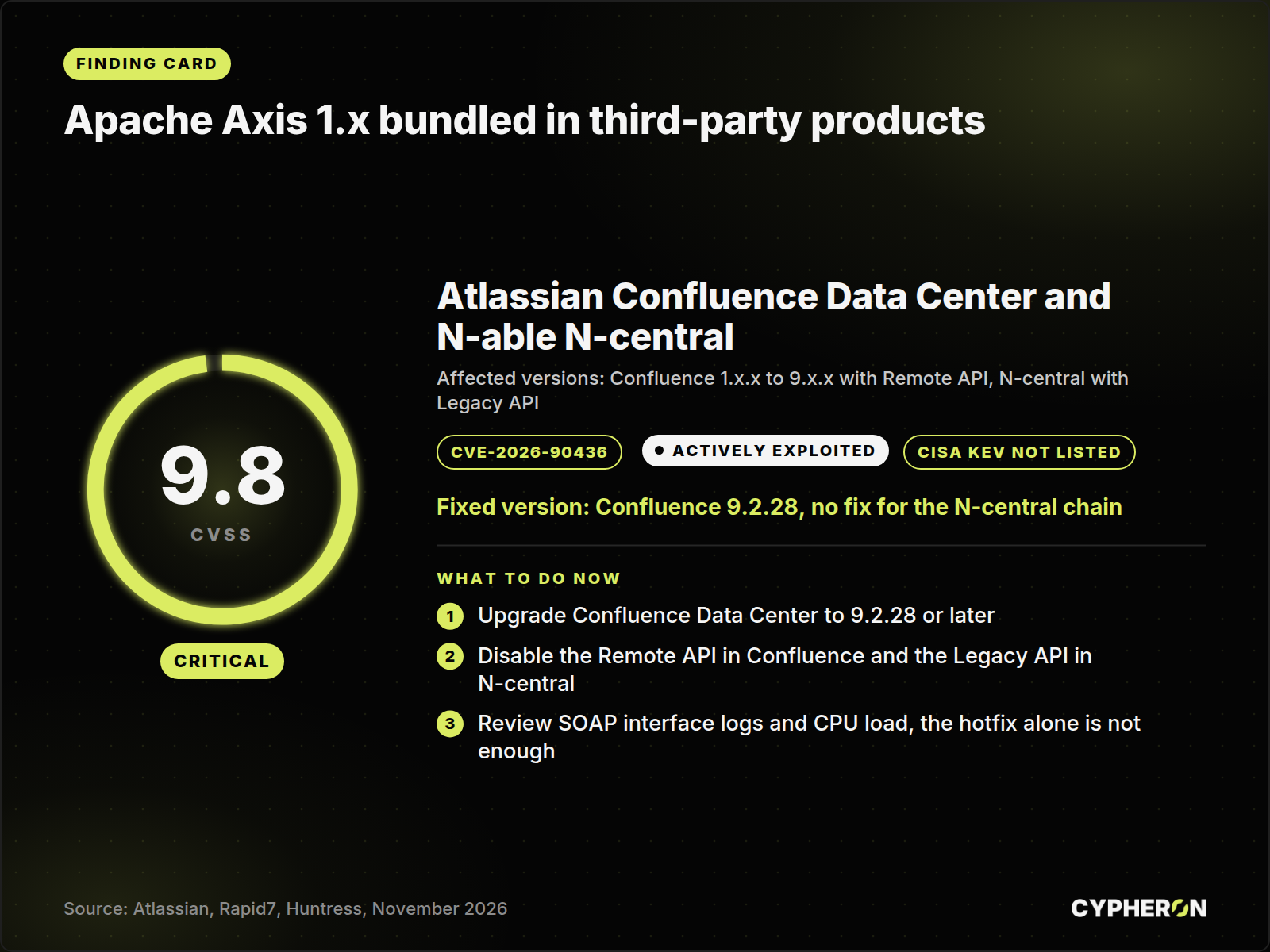
Since 12 November 2026 attackers have been exploiting a critical flaw in the Apache Axis 1.x library, which is bundled inside products of other vendors. Confirmed attacks so far target Atlassian Confluence Data Center and the remote management tool N-able N-central. The attacker needs no credentials and can run code on the server.
What happened
Apache Axis 1.x is an older Java library that handles SOAP web services. The project no longer maintains it and will not publish a fixed release. Every vendor that bundles Axis has to ship its own patch.
CVE-2026-90436, published on 6 November 2026, lies in the way Axis handles a class name carried in a SOAP message. The library loads the class and instantiates it before it verifies that the object really is a fault object. An attacker only has to send a crafted SOAP message to reach code execution without authentication. CISA assigned the flaw a CVSS score of 9.8.
Exploitation started with N-able N-central, where Axis is part of the web interface. A researcher published working exploit code on 12 November and, according to Huntress, the XMRig mining malware was running on at least 21 production N-central servers the same day. Nineteen of them ran build 2026.4.1.26, the version with the hotfix released on 10 November, which did not stop this attack. On 13 November N-able said it had found further indicators of compromise and was contacting affected customers.
On the same day the Rapid7 MDR team detected exploitation of the same flaw against Atlassian Confluence Data Center in a customer environment and published its report on 16 November 2026. As of 16 November 2026 the flaw is not listed in the CISA Known Exploited Vulnerabilities catalogue.
Does this affect you?
Confluence Data Center versions 1.x.x to 9.x.x, according to the Atlassian advisory of 9 November 2026, and only when the Remote API (XML-RPC and SOAP) is enabled. For new installations this setting has been off since Confluence 3.0 and the feature was removed entirely in version 10.0. Confluence hosted in the Atlassian cloud (atlassian.net addresses) is not affected and needs no action.
N-able N-central run on your own server with the Legacy API enabled and reachable from the internet. The Legacy API is disabled by default. According to N-able, environments hosted by the vendor are not affected by the server-side flaw.
In-house and supplied Java applications that bundle Axis 1.4 or older. Review dependencies on the axis:axis and org.apache.axis:axis packages and ask your software suppliers for a statement.
What to do now
- Upgrade Confluence Data Center to 9.2.28 or later. If that is not possible straight away, disable the Remote API (XML-RPC and SOAP) in the administration console. Without it the flaw cannot be used.
- On N-central, disable the Legacy API and remove the interface from the internet. The hotfix alone is not enough: servers running build 2026.4.1.26 were compromised too, and as of 14 November 2026 there was no fix for the full attack chain, with another hotfix in preparation.
- Find out where else Axis 1.x runs in your organisation and restrict access to those SOAP interfaces to the internal network.
How to tell whether you have been compromised
Checking the version is not enough, because patched N-central servers were hit as well. Review web interface access logs for requests to XML-RPC and SOAP endpoints that do not belong to normal operations, and look for unusual processes and sustained high CPU load, which on compromised N-central servers was caused by the XMRig mining malware. Since 13 November N-able has been publishing further indicators of compromise and contacting affected customers, so follow its advisories.
If you suspect a breach, treat it as an incident: disconnect the server from the network, preserve logs and memory, and only then patch.
Struggling to keep track?
Watching which of the dozens of new vulnerabilities each week actually affect your systems is a full-time job. We help organisations set up vulnerability management so that it is clear who follows vendor advisories, who decides on patching and within what deadline. A security assessment or an initial consultation is a good place to start.
Sources: Atlassian, advisory on CVE-2026-90436 in Confluence Data Center · Rapid7, exploitation detected against Confluence Data Center and N-central · Huntress, exploit chains against N-able N-central · BleepingComputer, exploited hours after the proof of concept was released