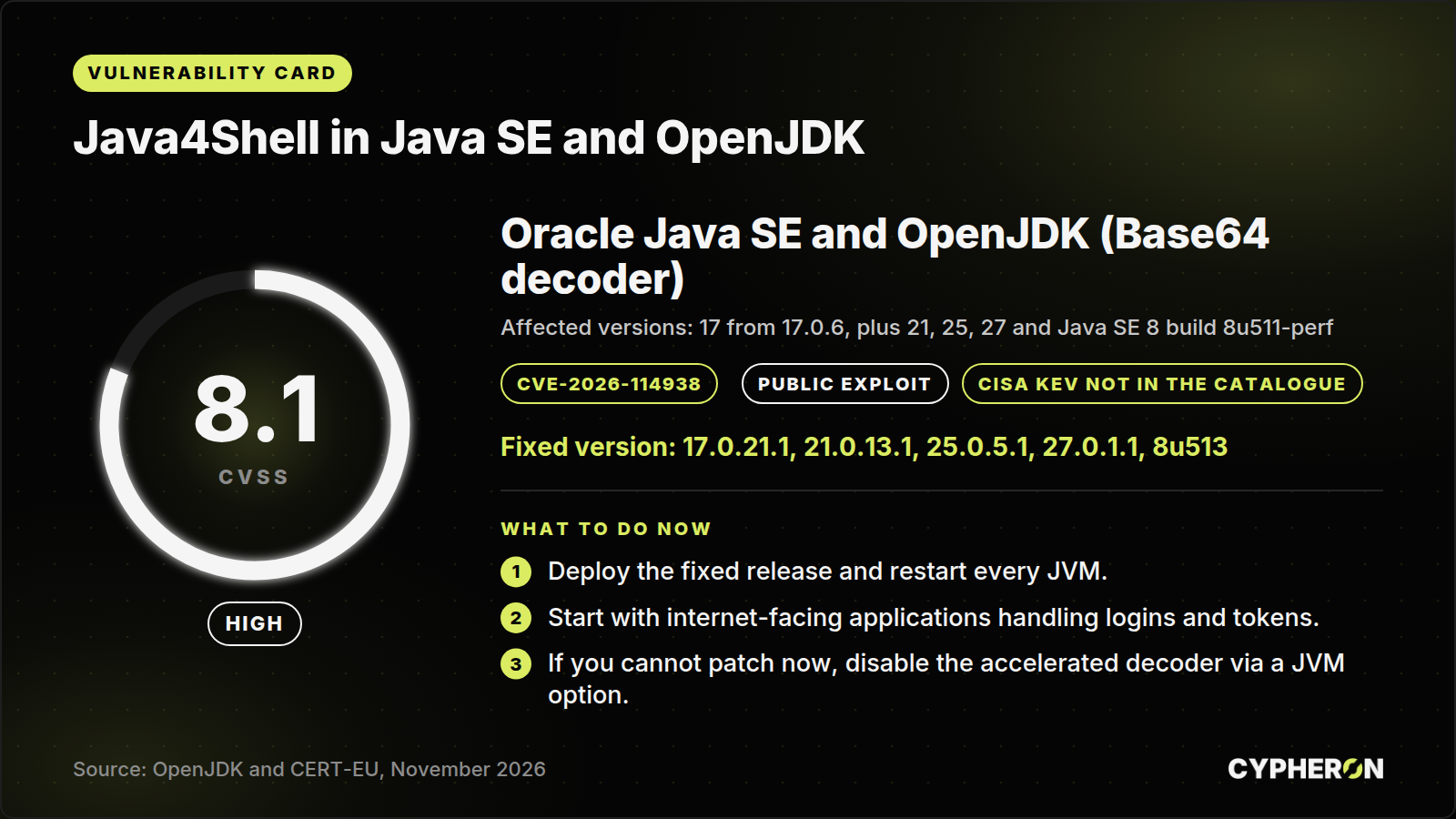
On 17 November 2026 Oracle and the OpenJDK project released fixes for CVE-2026-114938 in Java, a flaw the researchers who found it named Java4Shell. The flaw sits in the Base64 decoder and, under certain conditions, lets an attacker run code inside an application without logging in. The researchers demonstrated code execution without logging in against Keycloak, Atlassian Jira and Confluence, JFrog Artifactory and Jenkins, among others. As of 18 November 2026 nobody has confirmed successful exploitation in the wild, but GreyNoise has already seen exploitation attempts and internet scanning.
What happened
Java is the runtime behind a large share of corporate applications, from in-house systems to tools such as Keycloak, Atlassian products and JFrog Artifactory. Since version 17.0.6 it has included an accelerated Base64 decoder that uses the AVX-512 instructions of modern processors. That is where the flaw is. Base64-encoded data supplied by an attacker can make the runtime write beyond the memory it has reserved. According to CERT-EU this leads to denial of service, that is a crash of the application, and in some cases to unauthenticated remote code execution.
Base64 appears wherever binary data travels inside text: HTTP Basic authentication, JWT tokens, SAML messages, cookies or TLS data. An attacker therefore only needs the data to reach the decoder, and at a login interface that happens before the application verifies anyone.
According to the technical analysis by VulnCheck, the root cause is an integer underflow in the AVX-512 Base64 decode routine. An input longer than 128 bytes that ends in a short padded tail drives the decoded-size counter below zero, corrupts the destination pointer and writes roughly 62 bytes past the reserved space on the heap.
Severity ratings differ here, which is worth knowing. Oracle and the OpenJDK vulnerability group rate the flaw 8.1 out of 10 under CVSS 3.1, mainly because of the high attack complexity. Calif, the company that found it, rates it 9.2 under the newer CVSS 4.0 methodology, that is critical. What is public is proof-of-concept code that triggers the flaw without taking control of the system. Tenable reports that another researcher has a working exploit, and VulnCheck has one for its own customers.
Does this affect you?
CERT-EU lists these affected versions, with the fixed release in brackets:
- Java SE and OpenJDK 17 from 17.0.6 to 17.0.21 (17.0.21.1)
- Java SE and OpenJDK 21 up to 21.0.13 (21.0.13.1)
- Java SE and OpenJDK 25 up to 25.0.5 (25.0.5.1)
- Java SE and OpenJDK 27 up to 27.0.1 (27.0.1.1)
- Oracle Java SE 8 performance build 8u511-perf (8u513)
- Oracle GraalVM for JDK 17 and 21 (releases per the vendor)
Java 11 and standard Java 8 builds do not contain the accelerated decoder and are therefore not affected. Exploitation is also limited to systems where the JVM runs on an x86-64 processor with AVX-512 and bmi2 instructions, that is Intel Xeon Ice Lake and later and AMD Zen 4 and later. ARM64 systems are not affected. On a supported processor the acceleration is enabled by default. On Linux, a machine meets the condition when its processor reports all four of the avx512f, avx512bw, avx512vbmi and bmi2 flags.
Where your Java comes from matters too. Fixes for OpenJDK-based distributions such as Eclipse Temurin, Amazon Corretto, Azul Zulu, Microsoft Build of OpenJDK, BellSoft Liberica, SAP SapMachine and the Red Hat build of OpenJDK are released by their maintainers on their own schedules. Applications that ship their own runtime stay vulnerable until their vendor issues an update. You can check the version with java -version, but on application servers you need to check the JVM the service actually runs under.
Which applications are affected
The flaw is not in the applications but in the runtime underneath them. Any Java application that lets attacker-controlled data reach the Base64 decoder is therefore at risk. Calif tested a number of widely used applications in their default configurations, on an affected Java version and on a processor with AVX-512 VBMI. According to its results, as described by Tenable, it managed to run its own code as follows:
| Application | Result of the Calif test |
|---|---|
| Keycloak | code executed before login |
| Atlassian Jira | code executed before login |
| Atlassian Confluence | code executed before login |
| JFrog Artifactory | code executed before login |
| Jenkins | code executed before login |
| PingFederate | code executed before login |
| Apache Kafka broker | code executed only after login |
| Apache Solr | code executed only after login |
| Elasticsearch | code executed only after login |
| Gerrit | code executed only after login |
| Spinnaker | code executed only after login |
The list is not exhaustive. Calif adds that entirely everyday functions, such as authenticating a user or uploading a file, can lead to the affected code, so more applications than the ones tested will be exposed. Calif also ran its own code on sample applications built on Apache Struts and Spring Boot. That said, every application needs its own exploit, and a failed attempt usually crashes the application. Calif has not published exploits for individual products yet.
Servers are not the only thing at risk. According to Calif, a Java program that offers no service of its own can also be compromised when it connects over TLS to a server the attacker controls. A second way to abuse the flaw, which Calif calls JavaBleed, runs no code and only reads the application memory, which may hold keys and tokens.
Keycloak as an example of what this means in practice
Keycloak, a widely used server for sign-in and identity management, published its own guidance for administrators on 18 November 2026. It states the key point: the flaw is not in the Keycloak code, so updating Keycloak itself does not fix it. What needs fixing is the JDK on every node, or an image rebuilt on a fixed JDK, followed by a restart. Keycloak decodes Base64 in requests that arrive before authentication, so a login screen cannot be relied on as protection.
According to the same guidance, the x86-64 Keycloak container images tagged 26.8.2-1 and 26.8.2-2 bundled an affected OpenJDK 21.0.13 build as of 18 November 2026. The interim mitigation, also preferred by Red Hat, is to start every instance with -XX:-UseBASE64Intrinsics, on official images through the JAVA_OPTS_APPEND variable. After the restart you need to confirm with jcmd that the running JVM really reports UseBASE64Intrinsics = false. The Kubernetes Operator is a separate matter: it runs in its own process on OpenJDK 25, is configured through the JDK_JAVA_OPTIONS variable, and configuring it does nothing for the pods it manages. As of 18 November 2026 the project cannot recommend a fixed Keycloak image and will release new ones once patched OpenJDK builds are available.
The same holds in general. For an application that ships its own runtime, the version number of the application says nothing. What matters is which Java is bundled inside it.
How close is real exploitation
VulnCheck reproduced the flaw on an Ice Lake processor and distinguishes two levels. Crashing the JVM, that is causing denial of service, is easy: it is enough to send the malformed input repeatedly until the overflow hits a live object, and no preparation is needed. Code execution is substantially harder, because the attacker first has to groom the heap and find a way to leak memory addresses and thereby defeat ASLR, the random layout of memory. VulnCheck therefore does not expect easy or widespread exploitation, more likely narrow working paths in specific applications. It has had a full exploit for its own customers since 17 November 2026.
According to the Tenable summary, GreyNoise had seen exploitation attempts against this flaw as of 18 November 2026, but has not confirmed successful exploitation against its sensors. It also sees scanning from a publicly released scanner that looks for affected Java versions. CISA published an alert on 17 November 2026, and as of 18 November 2026 the flaw was not in its catalogue of known exploited vulnerabilities. No indicators of compromise have been published. According to CERT-EU the flaw most often shows up as a crash of the runtime, so unusual crashes of Java applications after 17 November 2026 are worth investigating.
What to do now
- Deploy the fixed release for your line and then restart every JVM. Without a restart the fix does not take effect.
- Start with internet-facing applications that process logins, tokens or SAML messages. CERT-EU recommends the same priority.
- Among those, put first the ones where researchers demonstrated code execution without logging in: Keycloak, Jira, Confluence, JFrog Artifactory, Jenkins and PingFederate.
- If you cannot update straight away, disable the accelerated decoder with the JVM options
-XX:+UnlockDiagnosticVMOptions -XX:-UseBASE64Intrinsics, or limit the use of AVX-512 with-XX:UseAVX=2. The second option can slow down other parts of the application. Both require a JVM restart. - Verify the setting with
java -XX:+PrintFlagsFinal -version | grep UseBASE64Intrinsics, and on a running service withjcmd <pid> VM.flags -all. - Check every node the service can run on, including standby nodes and nodes used during a rolling update. A check on one machine says nothing about the rest.
- For applications with a bundled runtime, ask the vendor for a patch date and in the meantime ask whether the JVM workaround is supported.
Struggling to keep track?
Java tends to be managed in pieces. One version sits in containers, another on the application server and a third inside an application from a vendor, so it is easy for a patch to miss something. We help companies define who tracks fixes for runtimes and libraries, how those fixes reach production and what happens when a vendor is late. Get in touch through our contact page; the initial consultation is free of charge. If you are dealing with an attack right now, use the incident response page.
Sources: OpenJDK, vulnerability advisory of 17 November 2026 · CERT-EU, advisory 2026-021 on Java SE and OpenJDK · Oracle, Java SE 17.0.21.1 release notes · Keycloak, guidance for administrators on CVE-2026-114938 · NVD, CVE-2026-114938 record · VulnCheck, technical analysis of Java4Shell · Tenable, Java4Shell frequently asked questions