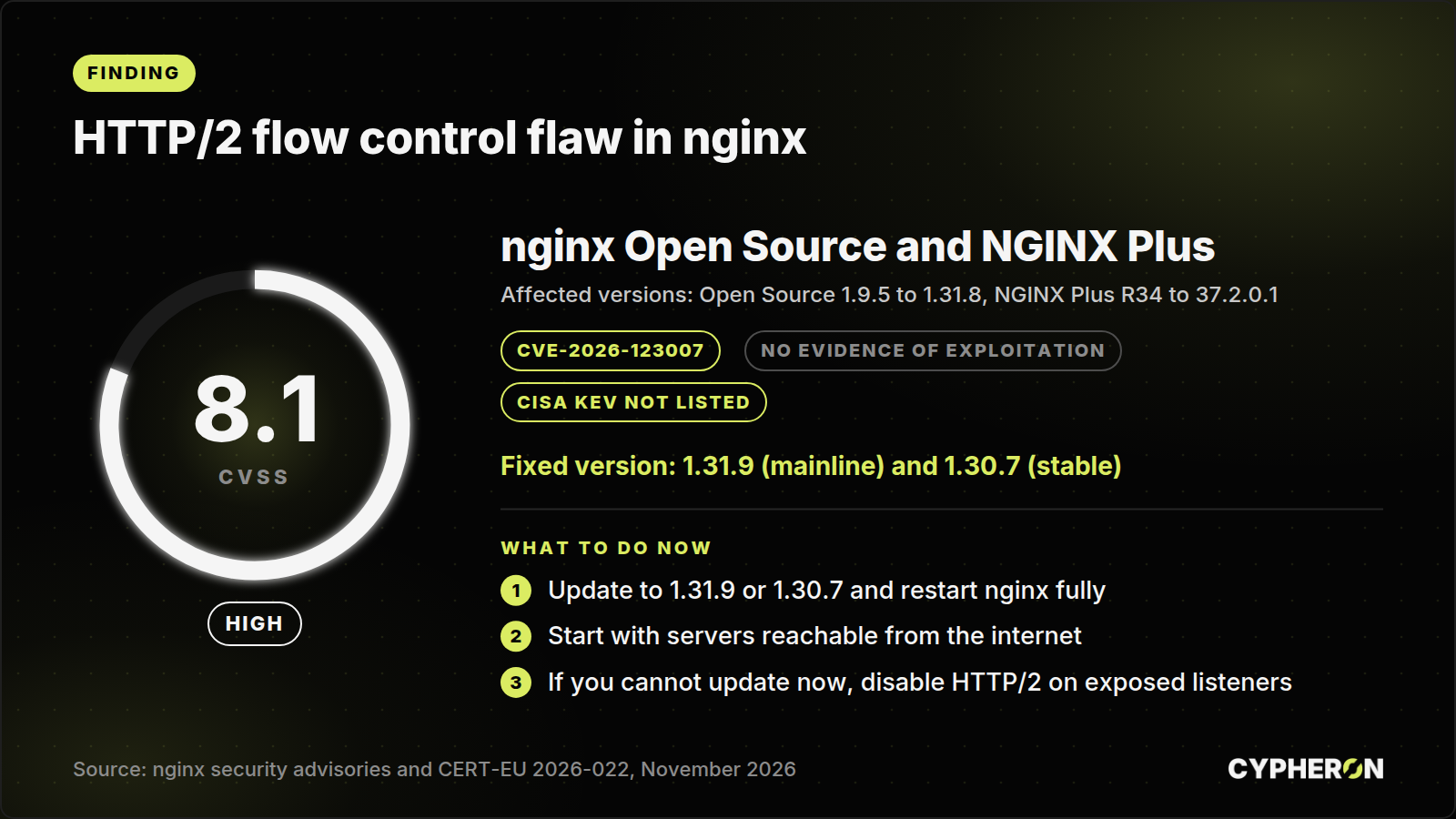
On 18 November 2026, F5 released fixes for five vulnerabilities in nginx. The most serious one, CVE-2026-123007 in HTTP/2 flow control, allows an attacker to run code on the server without logging in. No exploitation in the wild has been reported so far, but the flaw has been in the code since version 1.9.5 released in 2015 and proof-of-concept code is public.
What happened
nginx is a web server and reverse proxy that runs a large share of public websites and internal applications. CERT-EU published advisory 2026-022 on 18 November 2026 and rates all five flaws 8.1 out of 10. According to CERT-EU, all five can lead to remote code execution without authentication, with the privileges of the nginx worker process.
The code therefore does not run as root. To take over the whole server, an attacker would need a second flaw for privilege escalation. Code execution also requires ASLR (address space layout randomisation) to be disabled or bypassed, according to the vendor description; the researchers who reported the flaw bypassed ASLR in their tests. Without that, the result is a crash of the worker process, meaning a service outage.
| CVE | Where the flaw is | What the setup needs |
|---|---|---|
| CVE-2026-123007 | integer overflow in HTTP/2 flow control, out of bounds write on the heap | HTTP/2 enabled on a listening port |
| CVE-2026-123633 | use after free in HTTP/2 | HTTP/2 enabled and requests passed to an upstream server |
| CVE-2026-121810 | use after free in HTTP/3 | HTTP/3 enabled and requests passed to an upstream server |
| CVE-2026-123634 | use after free in the DNS resolver waiting list | a resolver configured, a proxy_pass target built from request data and mirror with mirror_request_body off |
| CVE-2026-113425 | use after free in the mail proxy module | mail proxy with proxy on and auth_http |
The first one is the easiest to reach. According to CERT-EU, the only precondition is HTTP/2 enabled on a listening port. The nginx project rates it as major in its security advisories, together with the mail proxy flaw; the remaining three are rated medium.
Does this affect you
According to CERT-EU and the nginx security advisories, the following versions are affected:
- nginx Open Source, mainline branch from 1.9.5 to 1.31.8, with the exact range differing per flaw,
- nginx Open Source, stable branch 1.30.x including 1.30.6, and older branches such as 1.28,
- NGINX Plus 37.0.0 to 37.0.7.1 and 37.1.0 to 37.2.0.1, and according to CERT-EU also releases R34, R35 and R36.
You can check the version with nginx -v. Be careful with packages from Linux distributions: a distribution usually backports the fix into its package without changing the version number that nginx reports. Compare the full package version with the advisory from your distribution. According to its page for CVE-2026-123007, Ubuntu has fixed packages for releases 26.10, 26.04 LTS, 24.04 LTS and 22.04 LTS, with older releases covered only under Ubuntu Pro.
Whether the server accepts HTTP/2 is visible in the configuration (a listen directive with http2, or http2 on) and can be verified from outside with openssl s_client -alpn h2 -connect address:443. If the output contains ALPN protocol: h2, the server accepts HTTP/2. If the site sits behind a CDN, test the origin server itself, not the CDN address.
What to do now
- Update nginx Open Source to 1.31.9 (mainline) or 1.30.7 (stable). According to the nginx project, both versions fix all five flaws.
- For NGINX Plus, deploy the fixed build listed in the F5 advisory K000164058.
- After updating, restart nginx fully or use the live binary upgrade. A reload alone leaves the old executable and old worker processes running.
- Start with servers reachable from the internet, as CERT-EU recommends.
- If you cannot update immediately, disable HTTP/2 on exposed listeners (
http2 off;and removehttp2from thelistendirective). According to CERT-EU this mitigates CVE-2026-123007 and CVE-2026-123633, but not the other three. Where you do not need HTTP/3, disable it as well. - For the resolver flaw, avoid building the
proxy_passtarget from variables and avoid the SSI and mirror directives. For the mail proxy, limit listeners to trusted networks.
How to tell whether you have been attacked
CERT-EU recommends watching for crashes of worker processes, meaning entries such as worker process ... exited on signal in the nginx error log. That is not proof of a successful attack, rather a sign of an attempt, and it needs to be combined with process creation logs and a look for programs that an nginx worker does not normally start. A clean access log does not rule out an attack, because HTTP/2 control frames do not appear in it as requests.
No time to track this
Watching vendor advisories every day and deciding what to deploy immediately and what can wait takes time that a small IT team usually does not have. We help organisations set up vulnerability management so that it is clear who decides about deploying fixes, within which deadlines and on which systems. If you need that role from outside, have a look at our security leadership service or arrange an introductory consultation.
Sources: nginx security advisories, affected and fixed versions · CERT-EU 2026-022, description of the flaws and recommendations · F5 K000164058, vendor advisory · Ubuntu, status of nginx packages · The Hacker News, summary of the research findings